

The Real Ceremony Begins After the Ceremony
One of the things Catalina said during our conversation that stayed with me long after we stopped recording was this:
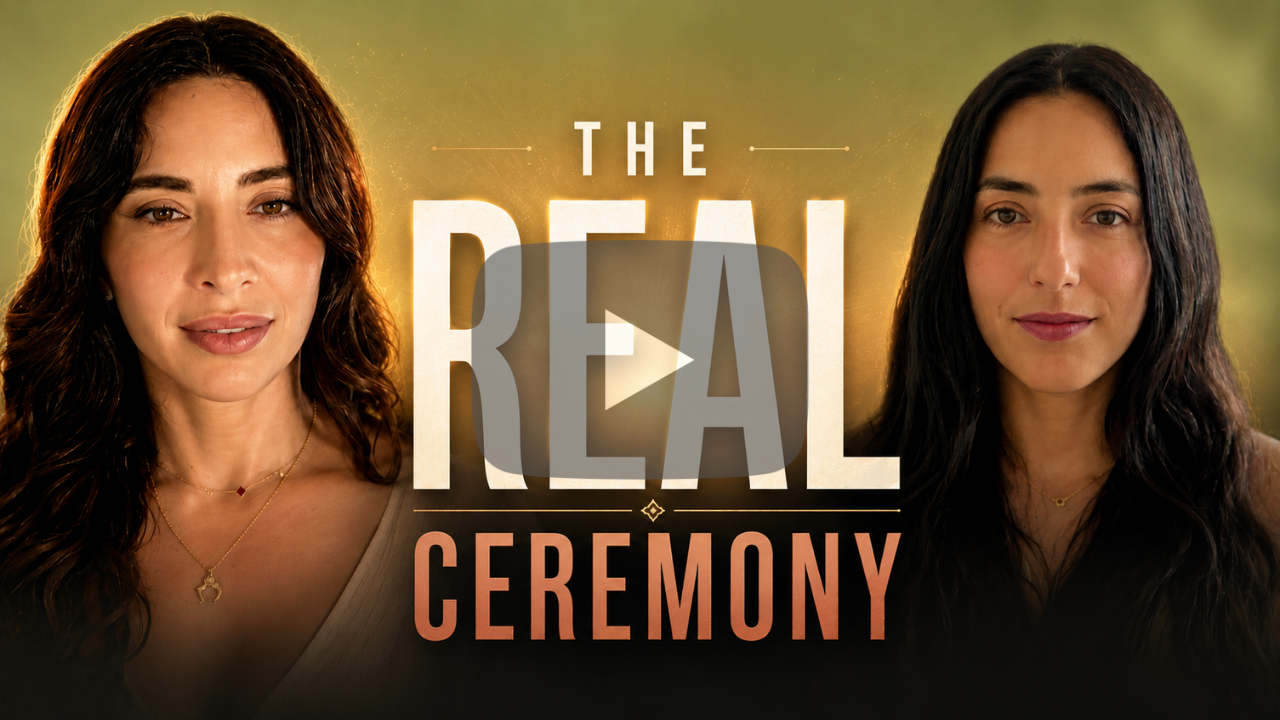
"The real ceremony begins after the ceremony."
The moment she said it, I knew exactly what she meant.
Not because I had heard those words before, but because I've spent so much of my life discovering that the moments that changed me the most weren't necessarily the ceremonies themselves. They were what happened afterward.
Of course, ceremonies can be beautiful. They can open our hearts. They can help us see things we've been unwilling to see. They can reconnect us with parts of ourselves that we've forgotten. I've had experiences that completely changed the direction of my life.
But when I look back honestly, the transformation wasn't in the insight.
The transformation was in the months that followed.
It was in the difficult conversations.
The boundaries I didn't want to set.
The grief I didn't want to feel.
The identities I didn't want to let go of.
The choices that required me to stop negotiating with what I already knew was true.
And that's really what Catalina and I found ourselves talking about throughout this conversation.
Not healing as an event.
Not transformation as a peak experience.
But what it actually takes to live what you've been shown.
The Difference Between Healing and Transformation
One of the things I appreciate about Catalina's perspective is that she continually brings the conversation back to integration.
We live in a culture that loves breakthroughs.
We're fascinated by the moment of awakening.
The realization.
The ceremony.
The big emotional release.
And those moments matter.
But I've also noticed that sometimes people become attached to the experience of healing itself.
They move from ceremony to ceremony.
Teacher to teacher.
Modality to modality.
Always searching for the next insight.
The next answer.
The next thing that will finally change everything.
What if the answer isn't another breakthrough?
What if the invitation is to become more devoted to the wisdom you've already received?
That question landed deeply for me because when I look at the biggest changes in my life, they didn't happen because I learned something new.
They happened because I finally became willing to act on something I already knew.
Most people are not lacking awareness. They're struggling with embodiment.
There is a difference.
Awareness says, "I see the pattern."
Embodiment says, "I'm willing to change my life because of it."
Devotion Is Different Than Fixing Yourself
Another theme that kept emerging throughout our conversation was devotion.
And I loved this because so much of the personal growth world is built around the idea that we're constantly fixing ourselves.
There's always another wound.
Another shadow.
Another belief.
Another thing that needs healing.
And while healing is important, I don't think life is asking us to spend every moment trying to repair ourselves.
At some point, the question shifts.
At some point we stop asking, "What's wrong with me?"
And we begin asking, "What am I devoted to?"
Catalina spoke about discipline several times during our conversation, and I found myself reflecting on the root of the word.
Discipline comes from the Latin word discipulus, meaning student or disciple.
A disciple is devoted to something.
They're committed to something.
They're in service to something they love.
When I think about discipline that way, it feels completely different.
It's not punishment.
It's not forcing.
It's not controlling yourself.
It's the willingness to keep showing up for what matters, even when nobody is watching.
And maybe that's what integration really is.
Not perfection.
Not arriving.
But a daily devotion to becoming more congruent with what you know to be true.
Growth Often Comes With Grief
One of the places our conversation naturally moved was motherhood.
Listening to Catalina speak about becoming a mother reminded me of something I don't think we talk about enough.
Every transformation contains a loss.
Not because something has gone wrong.
But because every new identity asks something of the old one.
As she spoke about becoming a mother later in life, we found ourselves talking about grief. Not grief in the traditional sense, but the grief that accompanies any major transition.
The grief of who we used to be.
The grief of what no longer fits.
The grief of the life we imagined.
The grief of identities we've outgrown.
I've experienced this in my own life. I've watched clients experience it. I've watched friends experience it.
And what I've learned is that growth and grief are often traveling companions.
We celebrate the butterfly.
We rarely talk about the chrysalis.
We celebrate the new beginning.
We rarely honor what had to end for that beginning to become possible.
Sometimes transformation feels less like becoming someone new and more like allowing someone old to fall away.
Living the Ceremony
If there was one thing I hope people take away from this conversation, it's this:
The goal isn't the ceremony.
The goal isn't the insight.
The goal isn't even the healing.
The goal is learning how to live in deeper relationship with truth.
To me, that's what embodiment really means.
It's bringing what you've learned into the way you love.
The way you lead.
The way you care for your body.
The way you navigate uncertainty.
The way you make decisions.
The way you show up when life becomes uncomfortable.
Because eventually every ceremony ends.
Every retreat ends.
Every beautiful experience comes to completion.
And then life asks a simple question:
What are you going to do with what you've been shown?
That's where transformation begins.
And maybe that's why Catalina's words have stayed with me.
The real ceremony begins after the ceremony.
Connect with Catalina:
Instagram: @catalinaranjo