

Why Self-Trust Starts in the Nervous System
One of the questions I hear most often from clients is some version of:
"How do I trust myself?"
Sometimes it sounds like, "How do I know if this is the right decision?" Sometimes it sounds like, "What if I make a mistake?" Sometimes it's hidden underneath indecision, procrastination, overthinking, or constantly looking outside of ourselves for reassurance.
What I've noticed over the years is that most people think self-trust is something they need to figure out mentally. They imagine that if they just had enough clarity, enough information, or enough certainty, then they would finally feel confident enough to move forward.
But what if self-trust isn't primarily a mental process?
What if it begins in the body?
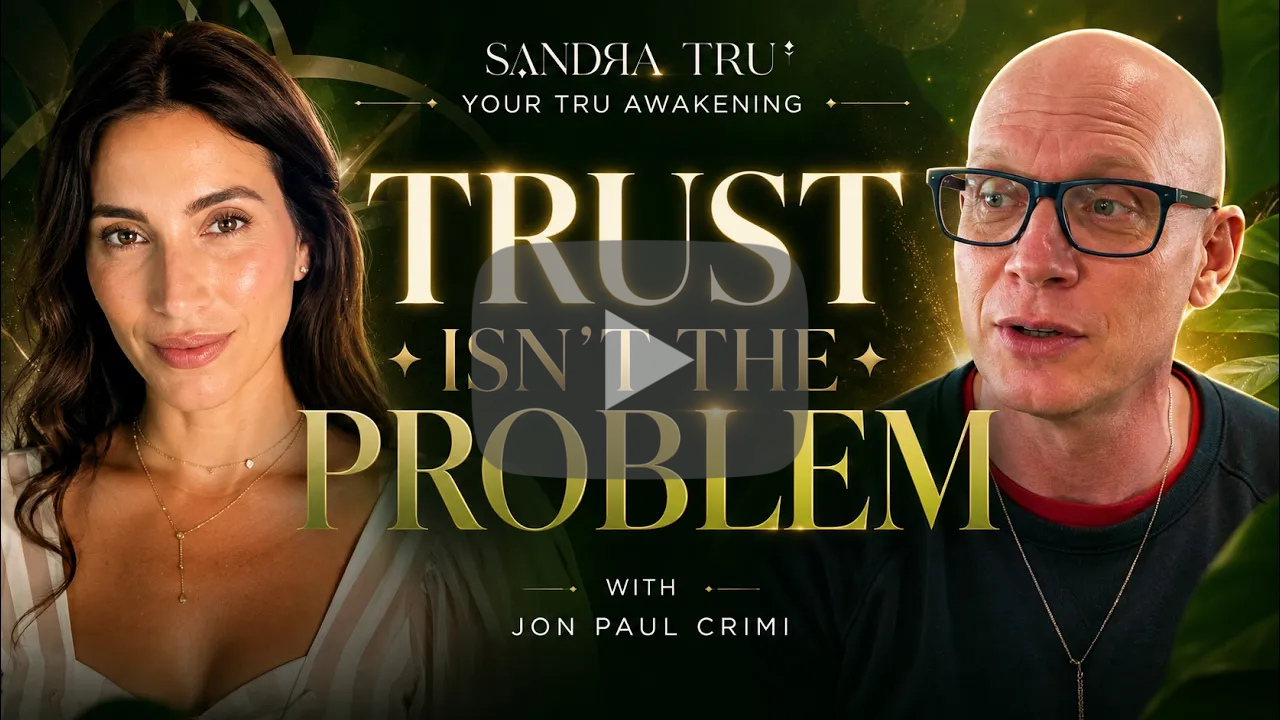
That was one of the most meaningful threads in my recent conversation with breathwork teacher Jon Paul Crimi.
As we spoke, we kept returning to the same realization: many people already know far more than they think they do. They know the relationship isn't aligned. They know the boundary that needs to be set. They know the opportunity they're being called toward. They know the conversation they've been avoiding.
The challenge is often not a lack of awareness.
The challenge is that their nervous system doesn't feel safe enough to act on what they know.
The Gap Between Knowing and Living
We live in a culture that values understanding.
From a very young age, we're taught to analyze, explain, interpret, and solve problems. We learn to trust logic and reason, and those are beautiful capacities. They have their place.
But there is a difference between understanding something and embodying it.
You can understand why you struggle with boundaries and still find yourself saying yes when you mean no.
You can understand the origins of a fear and still feel frozen when it's time to take action.
You can understand your patterns around relationships and still find yourself repeating them.
Many people spend years gathering insight while wondering why their lives aren't changing.
The reason isn't that they're doing anything wrong. It's that awareness is only one part of transformation.
At some point, what we know intellectually has to become something we can actually live.
When the Body Doesn't Feel Safe
One of the things I appreciated most about Jon Paul's perspective is how simple he makes something that can often feel complicated.
He spoke about how many of us are unconsciously holding our breath, breathing shallowly, and living from a state of subtle contraction. Not because we're broken, but because somewhere along the way our system learned that certain feelings were unsafe.
Maybe it wasn't safe to be angry.
Maybe it wasn't safe to be disappointed.
Maybe it wasn't safe to speak up.
Maybe it wasn't safe to take up space.
So we learned to tighten around those experiences.
We learned to manage them.
We learned to think about them instead of feel them.
The mind became the manager while the body carried the burden.
The problem is that what we don't allow ourselves to feel doesn't disappear. It simply waits.
It waits in our reactions, our relationships, our habits, and our decisions.
And often, what we call a lack of self-trust is really a nervous system that is still trying to protect us from something it believes is dangerous.
The Breath Brings Us Back to the Present
One of the reasons I have loved breathwork for so many years is because it creates an immediate relationship with the present moment.
Long before I began working with plant medicines or studying many of the modalities I use today, I was practicing yoga. And at the center of every practice was breath.
Not because breathing is trendy.
Because breathing changes our experience of reality.
The moment we slow down and bring conscious awareness to the breath, something begins to soften. We stop living entirely from our thoughts and start reconnecting with our direct experience.
We become aware of what we're feeling.
We become aware of where we're holding tension.
We become aware of the stories running in the background.
And perhaps most importantly, we become aware that we are not those stories.
We are the ones holding them.
The breath creates space between who we are and what we're experiencing.
That space is often where healing begins.
Healing Isn't Becoming Someone Else
There was a moment in the conversation where Jon Paul shared an idea that stayed with me.
He spoke about healing not as becoming the best version of ourselves, but as learning to love the parts of ourselves we've rejected.
I think this is especially important right now because so much of the personal growth world has turned healing into another achievement.
Another thing to accomplish.
Another finish line to cross.
Another reason we're not enough yet.
But true healing has never felt like that to me.
Healing feels more like coming home.
It feels like becoming more honest.
It feels like being willing to sit with the parts of ourselves we've spent years trying to fix, improve, suppress, or outrun.
There is a tremendous amount of energy tied up in self-rejection.
And there is an incredible amount of freedom available when we stop fighting ourselves.
The Courage to Feel
One of the things we explored in the conversation is how often people stay trapped in stories because they haven't fully felt the emotions underneath them.
Not because they don't understand them.
Because they haven't experienced them completely.
Many of us have become experts at talking about our pain.
Far fewer of us have learned how to sit with it long enough for it to move.
When grief is fully felt, something changes.
When anger is fully acknowledged, something changes.
When fear is allowed to exist without immediately trying to get rid of it, something changes.
The emotion moves.
The energy moves.
And often what remains is a deeper relationship with ourselves.
That relationship is the foundation of self-trust.
Not certainty.
Not perfection.
Not having all the answers.
Simply knowing that whatever arises, you are willing to stay with yourself.
Self-Trust Is Remembering Who You Are
The older I get, the less I think self-trust is something we build and the more I think it's something we remember.
It's what naturally emerges when we stop abandoning ourselves.
When we tell the truth.
When we listen.
When we create enough stillness to hear the wisdom that has been there all along.
The breath is one of the simplest ways I know to begin that process.
Not because it gives us the answers.
Because it helps us become present enough to hear them.
And perhaps that is where self-trust really begins.
Not in the mind.
Not in certainty.
But in the willingness to stay connected to ourselves, one breath at a time.